What Size Jar Holds 100 g of Snacks? A Practical Guide to Grams and Millilitres
A 100 g snack does not always need a 100 ml jar. How to weigh, measure and trial-fill real jars, with a worked example and a record table to use before you order.
A 100 g snack does not always need a 100 ml jar, and no single millilitre figure works for every snack. Grams measure weight, while millilitres tell you how much space the snack takes up. In the FAO/INFOODS examples below, 100 g takes from about 145 ml (shelled peanuts) to about 1,110 ml (potato chips).
Choosing a size comes down to three things: how many millilitres your snack really fills, whether the pieces pass through the jar opening, and whether the lid closes without pressing on the snack. The most reliable method is to weigh the snack at the weight you will sell, then trial-fill a real jar and close it the same way you will when packing for sale.
Why the same 100 g needs different jar sizes
Snacks differ in how dense or airy each piece is, and in how much space is left between pieces. Even with the same recipe, cutting bigger pieces or arranging them differently changes how much room the snack takes in the jar.
The FAO/INFOODS food density database defines bulk density as the mass of many pieces divided by the total volume they occupy. That volume includes the pieces themselves, the gaps between them and the pores inside them. Values from the database show how widely foods differ:
Food (FAO/INFOODS entry, shortened) | Bulk density (g/ml) | Space taken by 100 g, approx. |
|---|---|---|
Peanuts, shelled | 0.69 | 145 ml |
Cashews | 0.5 | 200 ml |
Almonds | 0.46 | 215 ml |
Muesli with fruit and nuts | 0.37 | 270 ml |
Peanuts, unshelled | 0.27–0.38 | 265–370 ml |
Potato chips | 0.09 | 1,110 ml |
The right-hand column is calculated as 100 ÷ bulk density. The values are compiled from several overseas sources and show scale only; they are not values for your snack. Look at unshelled and shelled peanuts: changing only the form of the food changes the figure a lot. Always test your own snack.
Another source of confusion is that grams and millilitres describe different things. Thailand's Ministry of Public Health (MOPH) Notification No. 450 (B.E. 2567/2024) on labelling of prepackaged foods requires the quantity of food in metric units: solid foods show net weight and liquid foods show net volume. A dry snack therefore shows grams on its label, while the millilitre figure is the jar's capacity.
Trial-fill in four steps
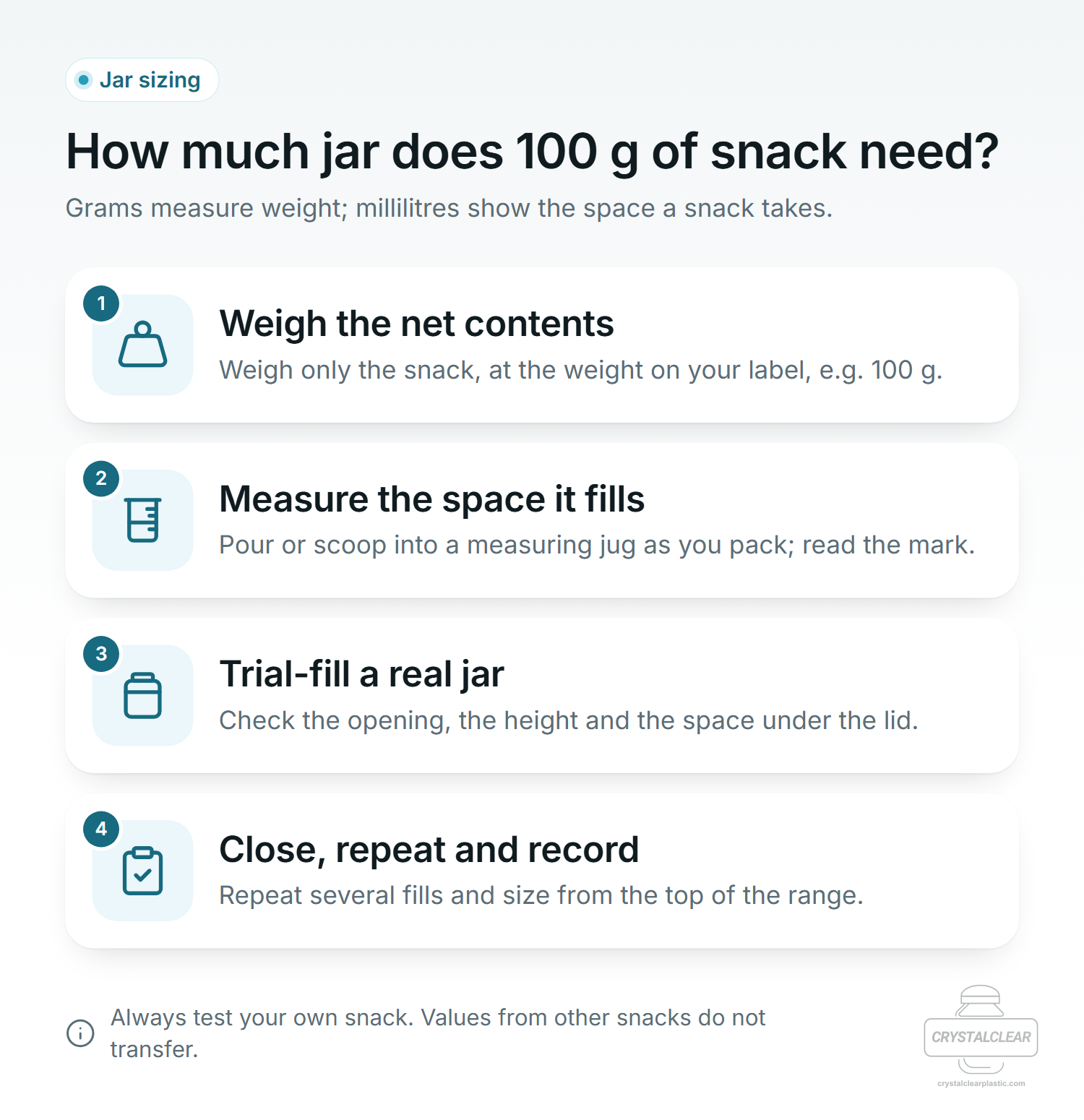
- Weigh the net contents. Use a real production batch: the same recipe, pieces the size you will sell, cooled as they would be for packing. Put your container on the scale and press Tare first, then weigh only the snack at the weight you will print on the label, for example 100 g.
- Measure the space it fills. Put the snack into a wide measuring cup or jug marked in millilitres, pouring or scooping it the same way as when you pack. Level the top and read the mark. Do not press or shake it down unless you do that when packing.
- Trial-fill a real jar. Use the jar model you plan to use. Check the opening, the height, the shoulders and how far the lid or inner cap reaches down inside. If you will use an inner bag or a liner, include it. Large pieces such as cookies especially need a real-jar trial, because they settle differently in a measuring cup than in a jar.
- Close, repeat and record. Fit the inner cap and lid as you will for sale and check whether the lid presses on the snack. Try about five times to see how much the figures vary, and do more if you produce large volumes or batches vary a lot. (Five is a starting suggestion, not a sampling standard.) Record every result in the record table below, then size from the highest figure you get.
What to check when you trial-fill
Check | What to look for |
|---|---|
Opening | Can the largest pieces go in and come out easily? |
Shape and shoulders | Are there corners the snack cannot reach or is hard to arrange in? |
Space under the lid | Do the lid and inner cap fit fully without pressing on the snack? |
Look when filled | Does the jar look full enough to buy, or does it look half-empty? |
After shaking or transport | How much does the snack settle, break or drop in level? |
Label area | Is there room for the label and the text it must carry? |
On labels, MOPH Notification No. 450, clause 15(3), sets a minimum letter height for the net quantity, main ingredients, allergen information and date:
- labels of up to 100 cm²: at least 1 mm
- labels larger than 100 cm²: at least 1.5 mm
Measure the label area on the real jar before you design the label.
Worked example (hypothetical figures)
The figures in this section are invented for illustration only. They are not values for any particular snack and not test results for the jar on the cover.
Suppose 100 g of a snack fills 220 ml. To sell 150 g of the same snack, scale it in proportion:
- Estimated volume = 220 × 150 ÷ 100 = 330 ml
- This equals a bulk density of about 100 ÷ 220 ≈ 0.45 g/ml.
Use this calculation to shortlist jar sizes to trial, and only while the recipe, piece size and packing method stay the same. With large pieces, a different jar shape may hold more or less than the calculation suggests.
If repeated trials of 100 g fill 210–235 ml, size from the top of the range (235 ml) so that even the bulkiest fill still closes, then allow space under the lid based on your real closing trials.
Do not pick a jar from "100 g = 100 ml" or from a single try. Trial-fill and close real jars several times before a large order.
How much space to leave, and filling to the full weight
No single headspace percentage suits every snack. Leave only the space you need above the snack, and judge it from real closing trials.
OIML R 87, the international recommendation on the quantity of product in prepackages, says in its non-binding Annex E that reasonable empty space in a pack is not misleading when it serves a necessary function, for example:
- protecting the product
- meeting the needs of the machines that close the pack
- allowing for unavoidable settling during shipping and handling
A pack with excessive empty space that serves no such function is considered misleading.
The jar must also hold the full weight on the label. Section 63 of Thailand's Weights and Measures Act B.E. 2542 (1999) requires the quantity shown on packaged goods to match the quantity inside, within the tolerance set by the Minister of Commerce. According to the Ministry of Commerce's summary of the law, the Thai tolerances are in the Ministry of Commerce Notification on types of packaged goods, criteria and methods for showing quantity, and tolerances, dated 12 March 2018.
Internationally, OIML R 87 requires the average quantity to be at least the labelled quantity and allows individual packs only a limited shortfall: for a pack labelled 100 g, the tolerable deficiency (T) is 4.5 g. This is the international figure, not the Thai legal value.
In short, choose a jar that holds the full weight and still closes easily, not one where you must take pieces out to fit the lid, or one so large that the snack looks half-empty.
How to read catalogue capacity
Before you order, ask the seller two questions:
- What level is the stated capacity measured to: full to the brim, or to a set fill level?
- By how many millilitres can the capacity vary?
Catalogue capacity is not the same as the space you can actually fill, which also depends on the lid, the shape and the level you fill to.
If you have the jar in hand, you can measure its capacity with a kitchen scale. This adapts the US FDA's general method for the water capacity of containers (21 CFR 130.12), which was written for US standards of fill:
- Remove the lid, wash and dry the jar, and weigh it empty.
- Fill it with water to the top (the FDA method uses distilled water at 20 °C) and weigh it again.
- The difference is the weight of the water that fills the jar. One gram of water is about one millilitre (FAO/INFOODS lists water at 20 °C at 0.998 g/ml), so you can read the grams as millilitres.
Note: jar code 010 on the cover is an illustration only. It does not mean this model holds 100 g of every snack.
Record table before you order
Item | What to record |
|---|---|
Recipe and batch | Recipe name, production date and piece size |
Net contents | Grams per jar |
Measured volume | Each result, plus the minimum and maximum |
Jar and closure | Jar code, lid code and any inner cap or seal |
Filling method | Pouring, scooping or arranging; whether you tap or shake to settle the snack |
After closing and transport | Space above the snack, whether the lid presses on it, crumbs and how much the snack moves |
A fit trial helps you choose a size, but it does not tell you how long the snack stays crisp. MOPH Notification No. 450, clause 5(9), requires a date on the label with the words "ควรบริโภคก่อน" (best before) or "หมดอายุ" (expiry). Base that date on a separate shelf-life test, not on a fit trial.
The Canadian Food Inspection Agency (CFIA) explains that shelf-life studies use finished, packaged product from one production run, and are repeated after any change to the formulation, ingredient quality, packaging, production methods, processing equipment or sanitation. So if you change the jar or lid, test shelf life again with the new jar and lid.
Crystalclear is a packaging distributor. Once you have your selling weight, measured volume and photos of the real snack, send them through our contact page and we will help you look at jar and lid models close to the size you need, or browse products first.
Related: Your First Packaging Order: What to Prepare Before Requesting a Quote · Starting a Sauce Brand: How to Choose Your Bottle and Closure
Sources
- FAO/INFOODS: Density Database Version 2.0 (2012)
- Thai FDA: Notification of the Ministry of Public Health (No. 450) B.E. 2567 (2024) Re: Labeling of Prepackaged Foods (unofficial English translation)
- Ministry of Commerce: Summary of the weights and measures law, Acts and secondary legislation, for the 2024 assessment of the law (Thai)
- OIML: R 87 Quantity of product in prepackages (Edition 2016)
- eCFR: 21 CFR 130.12 General methods for water capacity and fill of containers
- Canadian Food Inspection Agency: Shelf life studies
Sources checked on 7 October 2026.