
Starting a Sauce Brand: How to Choose Your Bottle and Closure
Choose a sauce bottle by texture, how customers pour or squeeze, and how you fill (room temperature or hot). Covers caps, Thai container and labelling rules, and a trial-fill checklist before a large order.
Start with the sauce, not with how the bottle looks. The right bottle has to suit your filling method, pour or squeeze easily, and hold up to the way you plan to store and sell the sauce. Before looking at bottle shapes, note down the facts about your actual sauce: its thickness, any chilli or garlic pieces, the filling temperature, and whether it will be sold chilled or at room temperature.
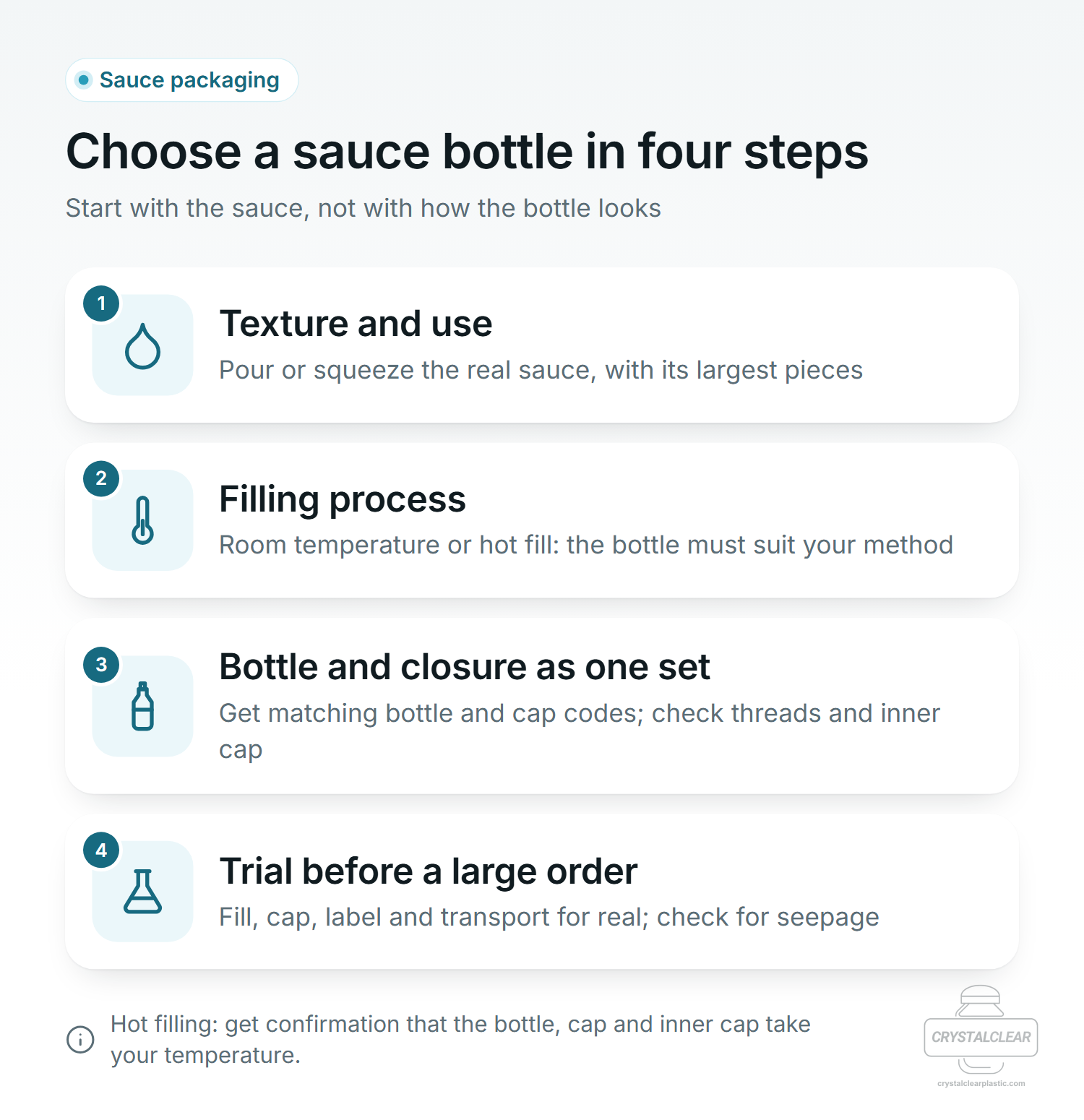
This guide covers four steps to work through before ordering bottles and caps: texture and use, filling process, bottle and closure as one set, and a trial before a large order. It also covers the Thai container and labelling rules worth knowing before your first order.
Sauce texture and how customers pour or squeeze
Try pouring the actual sauce the way customers will use it, for example straight from the fridge or after standing at room temperature. Then decide how it should come out: a steady stream, small drops, a squeezed line, or with the chilli and garlic pieces coming out together with the liquid.
Sauce type | What to test with the bottle and cap |
|---|---|
Thin, free-flowing sauce | Can you control how much comes out? Does sauce drip down the side of the bottle? |
Thick sauce | Does it pour or squeeze out easily? How much is left on the base and sides? |
Chilli, garlic or other pieces | Do the largest pieces pass through the opening? Does it clog? Do the chilli and garlic pieces come out with the liquid or stay in the bottle? |
Needs shaking before use | Is there enough space in the bottle to shake it back together? Does sauce seep out at the cap when shaken? |
Used for drizzling or decorating food | Can you squeeze an even line and control the amount? |
If you want a squeeze bottle, test whether the bottle body is soft enough to squeeze, and test the cap too. A squeeze cap on its own does not make every bottle easy to squeeze.
Room-temperature or hot filling: know before you choose
Tell the distributor clearly how hot the sauce is when it goes into the bottle, how long it stays hot in the bottle, and whether the capped bottle is heated again, for example pasteurised in the bottle.
Room-temperature filling, hot filling and heating after capping are different conditions. A bottle that works for one may not work for another.
The hot-filling method called hot-fill hold means filling hot sauce into the bottle, capping it, turning it upside down while the sauce is still hot, and holding it for a set time. University of Minnesota Extension says glass or plastic containers used for this method must be specifically designed to withstand the high temperatures.
Kansas State University Research and Extension also notes that some plastic containers cannot handle the high temperatures of hot filling, and advises checking the container's specification for the maximum temperature it can withstand. So do not assume a PET bottle suits hot filling just because of its material.
UGA Extension (University of Georgia) says hot-fill hold is only for foods that are naturally acidic or acidified, and that the sauce generally needs to flow so the hot sauce reaches the whole inside of the container. The method is therefore not suitable for sauces too thick to flow readily.
The recipe, temperature and hold time should be set with a food process specialist (a process authority).
In Thailand, if you plan to sell a sealed sauce that keeps outside the fridge, check whether it falls under Ministry of Public Health (MOPH) Notification No. 469 (B.E. 2569/2026) on food in hermetically sealed containers. The notification has applied since 19 May 2026.
The Thai FDA Food Division's briefing summarises it as covering two groups, low-acid foods and acidified foods, that have been treated to kill or inhibit microorganisms, sealed in a container that keeps air out, and can be stored at normal temperature.
Whether your sauce falls under it depends on the recipe and production method, so check with the Thai FDA or a food process specialist before settling on a bottle and cap.
Before hot filling, ask for confirmation that the exact bottle, cap and inner cap you will use can take your temperature. The preservation temperature, hold time and how long the sauce keeps outside the fridge must be assessed by a specialist for your own recipe. This article does not set these values.
Food-contact information must match real use
Tell the distributor whether the sauce contains oil, how sour (acidic) it is, its main ingredients, how hot it is when filled and how long it stays in the bottle.
The US FDA has reference tables that list food types separately, such as acid aqueous foods and foods containing free oil or fat. They also list conditions of use by temperature, such as hot filled or pasteurised above 150 °F (about 66 °C), hot filled or pasteurised below 150 °F, and filled and stored at room temperature. So "Food Grade" on its own is not enough. You also need to know which foods and which temperatures it covers.
The US information above is for understanding only. It does not replace Thai law.
In Thailand, plastic packaging for food must comply with MOPH Notification No. 435 (B.E. 2565/2022) on the quality or standards of food packaging made from plastic. The notification and related guidance are on the Thai FDA Food Division's plastic packaging page. Points sauce brands should know:
- The cap counts as packaging. The notification defines packaging to include caps and stoppers, so the cap must meet the plastic packaging standard too, not just the bottle.
- General requirements. Packaging must be clean. Coloured packaging must use food-contact-grade colourants, with no colour migrating into the food. Any printed pattern or text must use ink that stays fixed and does not flake off into the food.
- No bottles made for other things. The notification bans using plastic containers made to hold things other than food, and containers that previously held or wrapped fertilisers, toxic substances or anything that may be harmful to health. A cosmetic or cleaning-product bottle that looks like a sauce bottle therefore cannot be used.
Chilli, tomato, papaya, flour and mixed sauces have their own standard under MOPH Notification No. 201 (B.E. 2543/2000) on certain sauces. Some dipping sauces may not fall into these five types, so check your product's food category with the Thai FDA.
Choose the bottle and closure as one set
An opening and a cap with similar size numbers will not necessarily fit together. Ask for the bottle and cap codes that are used together, check that the threads match, and ask whether an inner cap, cap liner or seal is also needed.
If you hot fill, the cap design matters as much as the bottle. The University of Minnesota says the lid for hot-fill hold must be a single piece designed for proper sealing. Standard water-bath canning lids with a separate ring and lid are not suitable and may leak.
Kansas State University also says containers for acid and acidified foods should ensure a hermetic seal, one that is airtight and watertight.
Test the actual bottle and cap like this:
- Close and open the cap by hand or with the machine you will actually use.
- Fit every part of the cap, then pour or squeeze the real sauce.
- Check for seepage at the mouth, the thread or around the inner cap.
- If you hot fill, invert the bottle as in your real process and check for seepage at the cap.
- Where the cap's specification gives a closing torque (how tightly to turn the cap), use that value rather than the same force for every bottle.
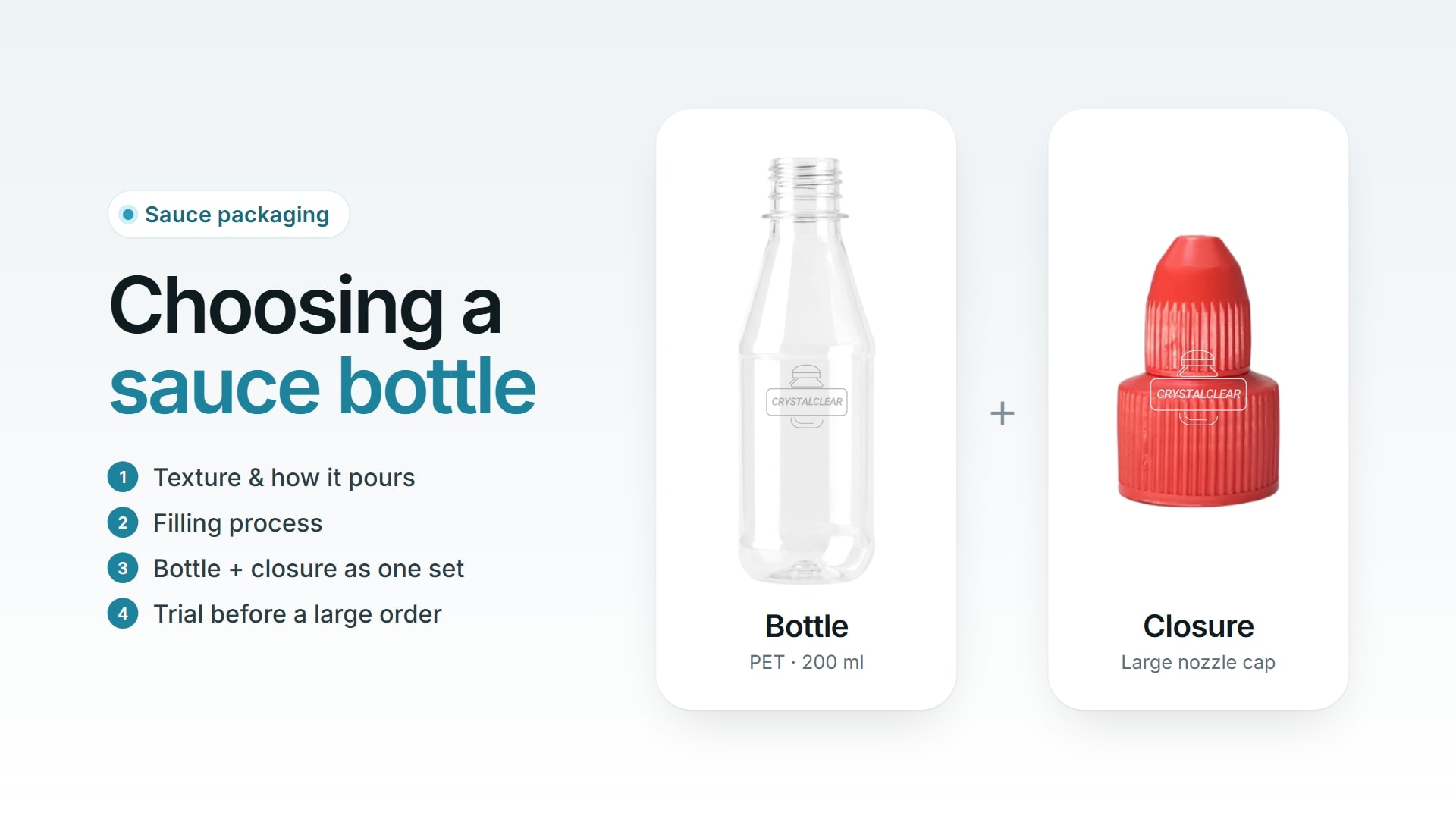
The cap on the cover is the large nozzle cap, which our product data lists as compatible with bottle 200ML. A cap that fits the bottle is not automatically right for your sauce or filling method, so still trial-fill, cap and pour your real sauce before ordering.
Fill quantity and label space
Start with the quantity you will sell per bottle and the unit you will show on the label. MOPH Notification No. 450 (B.E. 2567/2024) on labelling of prepackaged foods, in force since 19 July 2024, requires quantities in metric units. Liquid foods must show net volume (millilitres or litres); semi-solid foods may show either net weight or net volume.
Measure the actual sauce in that unit and do not treat grams and millilitres as interchangeable, because one gram of sauce is not always one millilitre. Hypothetical example: a thick sauce that may be labelled by weight weighs 115 g per 100 ml. A 200 g fill is therefore about 174 ml of sauce, not 200 ml.
Under Thailand's Weights and Measures Act B.E. 2542 (1999), section 63, the quantity shown on a package must match the quantity inside, within the tolerance set by the Ministry of Commerce. So set your fill level using the actual sauce in the actual bottle.
Also ask the distributor whether the stated capacity is measured brim-full or to a normal fill line, and plan enough space between the sauce surface and the cap (headspace) for your cap and filling method.
Measure the label area on the actual bottle, especially on curved shoulders or a waisted body, because some minimum letter heights depend on label area. The Thai FDA's summary of Notification No. 450 gives these minimums:
Label text | Minimum letter height |
|---|---|
Food name | 2 mm (1 mm allowed on labels smaller than 35 cm²) |
Food serial number | 2 mm |
Net quantity, main ingredients, allergen information, and best-before or expiry date | 1 mm on labels up to 100 cm²; 1.5 mm on labels larger than 100 cm² |
The Thai FDA's summary adds that the net-quantity text must also meet the Ministry of Commerce notification on packaged goods, whose letter-size rules are stricter, so check both before printing labels.
Print a full-size paper label, wrap it around the bottle, and check where the join falls, whether the label wrinkles, and whether a hand sits comfortably over it.
Checklist before a large order
- Test with the real recipe, including the largest chilli or garlic pieces you actually use.
- Get the bottle and cap specifications and confirm they suit your filling method and temperature. Check with the Thai FDA which food category your sauce falls into and which container rules apply.
- Fill, cap and label the way you will in production.
- Pour or squeeze, and check for seepage at the cap after transport.
- Store the filled bottles in the same conditions as for sale and transport, then check the results. This kind of bottle trial is not a shelf-life test. To find out how long the sauce keeps, test that separately.
Crystalclear is a packaging distributor. Send us details of your sauce and filling method to talk through bottle and cap options. Browse products or contact us.
Related: Your First Packaging Order: What to Prepare Before Requesting a Quote · What Size Jar Holds 100 g of Snacks?
Sources
- University of Minnesota Extension: Preserving food using hot-fill hold
- UGA Extension: Preserving Acidified Foods Using the Hot-Fill-Hold Process
- Kansas State University Research and Extension: Hot-Fill-Hold Process for Acid and Acidified Foods (MF3671)
- US FDA: Food Types & Conditions of Use for Food Contact Substances
- Thai FDA Food Division: ภาชนะบรรจุที่ทำจากพลาสติก (Plastic packaging, in Thai)
- Thai FDA: Notification of the Ministry of Public Health (No. 435) B.E. 2565 (2022) Re: Specification of Qualities or Standards of Food Packaging Made from Plastic (English translation; the Thai text prevails)
- Thai FDA Food Division: MOPH Notification No. 201 (B.E. 2543) on certain sauces, consolidated version (in Thai)
- Thai FDA Food Division: Summary of MOPH Notification No. 450 (B.E. 2567) on labelling of prepackaged foods (in Thai)
- Thai FDA Food Division: Briefing on MOPH Notification No. 469 (B.E. 2569) on food in hermetically sealed containers, lecture materials of 25 May 2026 (in Thai)
- Ministry of Commerce: Summary of the weights and measures law, Acts and secondary legislation, for the 2024 assessment of the law (in Thai)
Sources checked on 7 October 2026.