Your First Packaging Order: What to Prepare Before Requesting a Quote
A checklist for new brands on what to prepare before asking for a packaging quote, from the product, net contents and filling method to the container and closure, quantity and date, documents and price comparison, with a quote request you can copy.
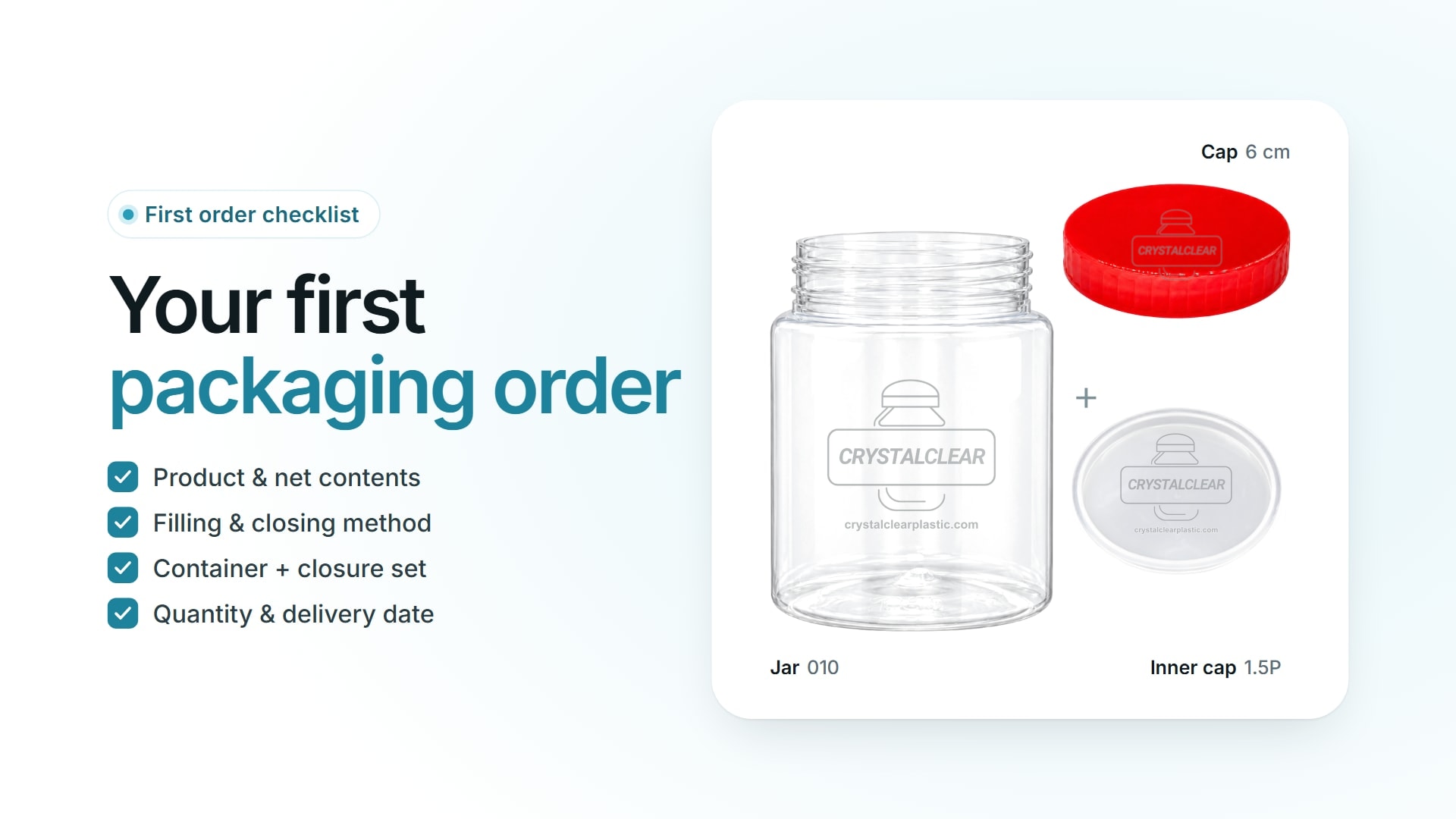
A packaging quote fits your needs better when the distributor knows what you will pack, how you will fill it and when you need it. You do not need a bottle or jar code or an exact size yet. Real product details, plus a note of what you still need to test, are enough to start asking.
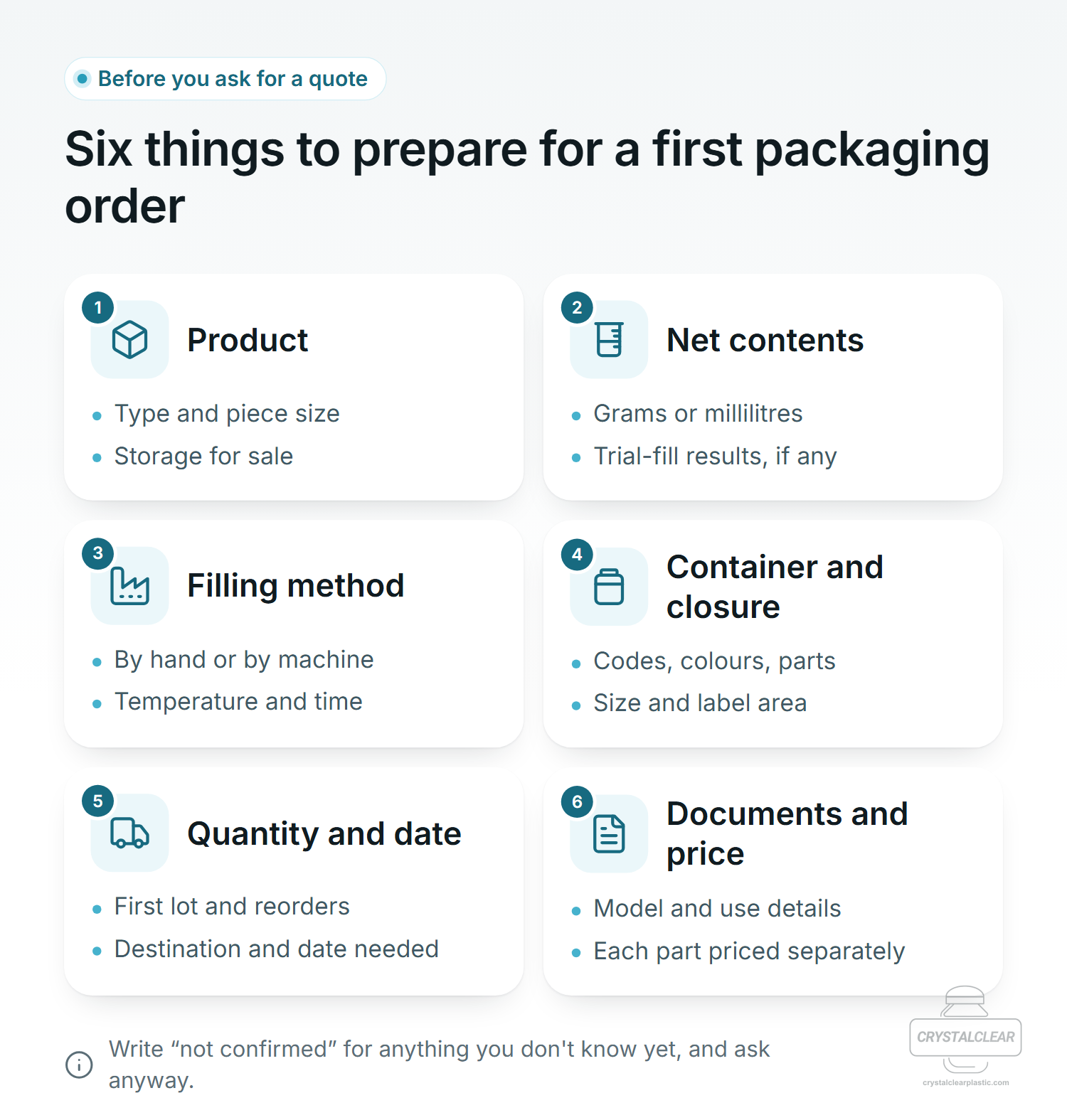
This checklist groups what to prepare into six areas. Send every distributor the same details and the quotes that come back can be compared directly. A quote request you can copy is at the end.
1. The product and how it will be stored
Say what the product is, such as cookies, nuts, dipping sauce or sauce, then describe the traits that affect the choice of container:
- how big the pieces are (give the size of the largest piece)
- thick or runny
- how oily it is
- whether it is sour (acidic)
- whether it contains chilli, garlic or other small pieces
Attach photos of the real product and say how it will be stored for sale, for example at room temperature or chilled.
If you give a shelf life, say clearly whether it is a target or a tested result, so the distributor does not take a target as a tested figure.
Oregon State University's Food Innovation Center in the US says shelf-life testing measures how long a food stays safe and keeps its quality, flavour, aroma and appearance under set storage conditions. It designs these studies for products whose recipe is fixed and that are in their final packaging. If you have not chosen the container yet, any figure you have is not yet a result in the final pack.
2. Grams or millilitres per unit
Say clearly whether the quantity is in grams or millilitres, and use the unit that fits the form of the food. Ministry of Public Health (MOPH) Notification No. 450 (B.E. 2567/2024) on labelling of prepackaged foods requires quantities in metric units, based on the form of the food:
Form of food | Quantity shown on the label as |
|---|---|
Solid | Net weight (or a count, where net weight cannot be shown) |
Liquid | Net volume |
Semi-solid or other | Either net weight or net volume |
Where an MOPH notification requires a drained weight, that must be shown too.
Every pack must actually contain the quantity on the label. Under the Weights and Measures Act B.E. 2542 (1999), section 63, the quantity shown on a package must match the quantity inside, within the tolerance set by the Ministry of Commerce.
The Ministry of Commerce's 2024 summary of the weights and measures law says the types of packaged goods covered, how quantity is declared and the tolerances are set in a Ministry of Commerce notification dated 12 March 2018. So the container you choose must hold the amount on the label every time.
If you have already trial-filled, attach the results, for example: “100 g of snack takes up about 210–235 ml.” (These are hypothetical figures, not a recommended size for every snack.)
If you do not know which jar size you need, don't guess. Send the weight you will sell, the piece size and photos of the product instead. See how to trial-fill in What Size Jar Holds 100 g of Snacks?
3. How you will fill and cap
Cover these four points:
- Filled and capped by hand or by machine
- Product temperature at filling (if hot filled)
- How long the product stays hot in the container
- Whether the closed container is heated again, for example pasteurised
If you are still developing the recipe or the filling process, write “not confirmed”. Don't give an estimate as if it were an agreed figure.
This information helps the distributor suggest models and documents that match your filling method. Thailand's main rule on plastic food packaging is MOPH Notification No. 435 (B.E. 2565/2022) on the quality or standards of food packaging made from plastic (see sections 4 and 6).
The US FDA's reference tables sort food types and conditions of use, such as hot filling or room-temperature filling and storage. They are useful background but do not replace Thai law.
If the product is heat-treated to control microorganisms, before or after filling, then sealed and sold outside the fridge, first check whether it falls under MOPH Notification No. 469 (B.E. 2569/2026) on food in hermetically sealed containers.
In force since 19 May 2026, it covers food heat-treated to destroy or inhibit microorganisms, packed in a sealed container that keeps outside air out, and able to be stored at normal temperature. Low-acid foods (pH above 4.6 and water activity above 0.85) must be heat-processed to the criteria the notification sets, or acidified to pH 4.6 or below (Clause 8).
Settle the process with the Thai FDA or a food process specialist first, then choose the container and cap.
4. Container, closure and parts
List each part you need:
- bottle or jar
- cap
- inner cap
- cap liner
- seal
If you already have model codes, give the code and colour of every part, and say which alternatives you would accept if a model or colour is unavailable.
Don't leave out the cap. MOPH Notification No. 435 defines packaging to include caps and stoppers (Clause 2), so ask for information and documents that cover the cap and its parts, not only the bottle or jar.
If you want a special colour or printing on the container, ask about the colourant and ink too. The same notification requires food-contact-grade colourants that do not migrate into the food, and printing ink that stays fixed and does not flake off into the food (Clause 4(5)–(6)).
Size and label. If the container must fit a carton, a shelf or a filling machine, give the maximum height and width. If your labels already exist, give their size. If they are not printed yet, measure the label area on the actual bottle or jar model you have chosen before printing.
The label itself is regulated too. Notification No. 450 requires labels to be permanent, not to peel or tear easily, to sit where they are clearly visible, and to be sized in proportion to the container (Clause 10). Text for the food quantity must be at least 1 mm high on labels up to 100 cm² and at least 1.5 mm high on labels larger than 100 cm² (Clause 15(3)). Before printing, also check how quantity must be declared under the Ministry of Commerce rule in section 2.
5. Order quantity and the date you need it
Give the quantity for your first order and, if sales go to plan, roughly how much you expect to reorder. Add the delivery province or postcode and the date you need the packaging in hand.
Questions to ask:
- What is the minimum order, per model or per colour?
- How many pieces are in a pack or carton?
- Is it in stock? If not, how long is the wait?
- How many days does delivery take?
- Until what date is the quoted price valid?
Minimum orders and lead times can differ by model. Don't apply one model's figures to all.
Work back from the date you need the packaging, and allow time for trial filling and reading the documents.
6. Documents and comparing prices
Ask for these details of each model you are considering:
- material of the container, cap and inner cap
- dimensions, capacity, and the level that capacity is measured to (brim-full or a normal fill line)
- which cap fits which bottle or jar
- the temperatures and uses the container is meant for
If you are packing food, ask which documents or test reports exist for that model, then read them to check that they really cover your product and filling method. MOPH Notification No. 435, its clarifications and related guidance are on the Thai FDA Food Division's plastic packaging page (in Thai).
When you read a test report, check three things:
- Who did the testing. Under a Thai FDA notification of 3 August 2022 on guidelines for accepting test results for food containers, the Thai FDA accepts results from three kinds of laboratory, in Thailand or abroad: those of government agencies, those of bodies a government agency has assigned or certified, and those whose competence is accredited under an international standard, for tests that match the accredited scope.
- What was tested. For example, the Department of Medical Sciences tests PET packaging under Notification No. 435 for five things: plastic identification, overall migration, migration of 19 heavy metals, 26 primary aromatic amines (PAAs) and specific migration (SML) of 3 substances.
- How long it takes. If you need to have packaging tested yourself, the Department of Medical Sciences said in a news release of 3 April 2025 that it can report results within 30 days. Check the current turnaround and allow for it in your plan.
A manufacturer's factory certificate and a test report for the model you will use are different documents. The certificate is issued to the manufacturer, not to the distributor.
Comparing prices. Don't compare one distributor's price for the bottle alone (without a cap) with another's price for bottle and cap. Ask for each part to be priced separately, so you can see what each price includes, and ask whether delivery and VAT are included.
Don't place a large order from photos or catalogue figures alone. Trial-fill your real product in the bottle or jar model you plan to order, using your real filling and storage method, and read the documents to make sure they name the model and a use that matches your product.
A quote request you can copy
Copy this and fill it in. Write “not confirmed” for anything you don't know yet.
- Product: … / Piece size or consistency: … / Storage for sale: … / Shelf life (target or tested): …
- Net contents per unit: … g or … ml / Trial-fill results: …
- Filling and capping: … / Temperature at filling: … / How long it stays hot: … / Heated after capping: yes or no
- Bottle or jar code: … / Cap and parts: … / Colour: … / Acceptable alternatives: … / Maximum height and width: … / Label size: …
- First-order quantity: … / Expected reorders: … / Delivery province or postcode: … / Date needed: …
- Documents requested: …
- Please price separately: container / cap and parts / delivery / VAT included or not
- Please tell me: minimum order / pieces per pack or carton / in stock or not / preparation time / delivery time / payment terms / price valid until
Four checks before confirming the order
- Model codes, colours, quantities and every part match what was agreed.
- You have trial-filled the real product in the chosen containers and caps, using the filling method and storage you will actually use.
- The price includes every cost, and you have agreed how the goods will be checked on arrival and how to report a problem.
- You know the date the goods leave the distributor and the date they are expected to reach you.
Crystalclear is a packaging distributor. Send the details from this checklist through our contact page to ask about models and request a quote, or look at models first on our products page.
Related: What Size Jar Holds 100 g of Snacks? · Starting a Sauce Brand: How to Choose Your Bottle and Closure
Sources
- Thai FDA Food Division: ภาชนะบรรจุที่ทำจากพลาสติก (Plastic packaging, in Thai)
- Thai FDA: Notification of the Ministry of Public Health (No. 435) B.E. 2565 (2022) Re: Specification of Qualities or Standards of Food Packaging Made from Plastic (English translation; the Thai text prevails)
- Thai FDA Food Division: ประกาศกระทรวงสาธารณสุข (ฉบับที่ 450) พ.ศ. 2567 เรื่อง การแสดงฉลากของอาหารในภาชนะบรรจุ (MOPH Notification No. 450 on labelling of prepackaged foods, in Thai)
- Thai FDA Food Division: ประกาศกระทรวงสาธารณสุข (ฉบับที่ 469) พ.ศ. 2569 เรื่อง อาหารในภาชนะบรรจุที่ปิดสนิท (MOPH Notification No. 469 on food in hermetically sealed containers, in Thai)
- Thai FDA Food Division: ประกาศสำนักงานคณะกรรมการอาหารและยา เรื่อง แนวทางการยอมรับผลการตรวจวิเคราะห์ภาชนะบรรจุอาหาร ขวดนม และภาชนะบรรจุนมสำหรับทารกและเด็กเล็ก (Guidelines for accepting test results for food containers, feeding bottles and milk containers for infants and young children, in Thai)
- Department of Medical Sciences: กรมวิทย์ฯ พร้อมให้บริการตรวจวิเคราะห์พลาสติกบรรจุอาหาร ชนิดพอลิเอทิลีนเทเรฟทาเลต (PET) ตามประกาศกระทรวงสาธารณสุขฉบับใหม่ (PET food-packaging testing under the new MOPH notification, in Thai)
- Ministry of Commerce: Summary of the weights and measures law, Acts and secondary legislation, for the 2024 assessment of the law (in Thai)
- US FDA: Food Types & Conditions of Use for Food Contact Substances
- Oregon State University Food Innovation Center: Shelf Life Testing
Sources checked on 7 October 2026. The checklist and quote request in this article are editorial guides to help you prepare, not a list of documents required by law.