Plastic Codes 1–7 Explained: How to Read Them and Choose and Use PET, HDPE and PP
The number in the triangle names the plastic — it doesn't say it's safe or recyclable. What plastics 1–7 are used for, how much heat they take, which can go in the microwave, how to read the label and how to sort plastic for recycling in Thailand.
Almost every plastic bottle, jar, cap or box carries a number from 1 to 7 inside a triangle. Many people read it as a sign that the item is safe or recyclable, but the number has one job: it tells you which plastic the item is made of. This guide explains plastics 1–7, how to use each one properly, how to read the label, how to sort plastic so it really gets recycled, and how brand owners can choose the right material.
What is the number in the triangle?
It is the Resin Identification Code. The US plastics industry association introduced it in 1988 to help sort plastic for recycling. Today it is defined in the ASTM D7611 standard, which in 2013 replaced the chasing arrows around the number with a solid triangle, because shoppers kept taking the arrows to mean "recyclable".
In Thailand the symbol is set out in TIS 1310-2538 (symbols for recycled plastics), which still uses chasing arrows. The Pollution Control Department groups plastics into the same 7 types to make sorting, collection and recycling easier.
The number only names the plastic. It does not tell you whether an item is safe for food, microwave-safe or recyclable where you live — and a lower number is not "better".
The seven plastic codes
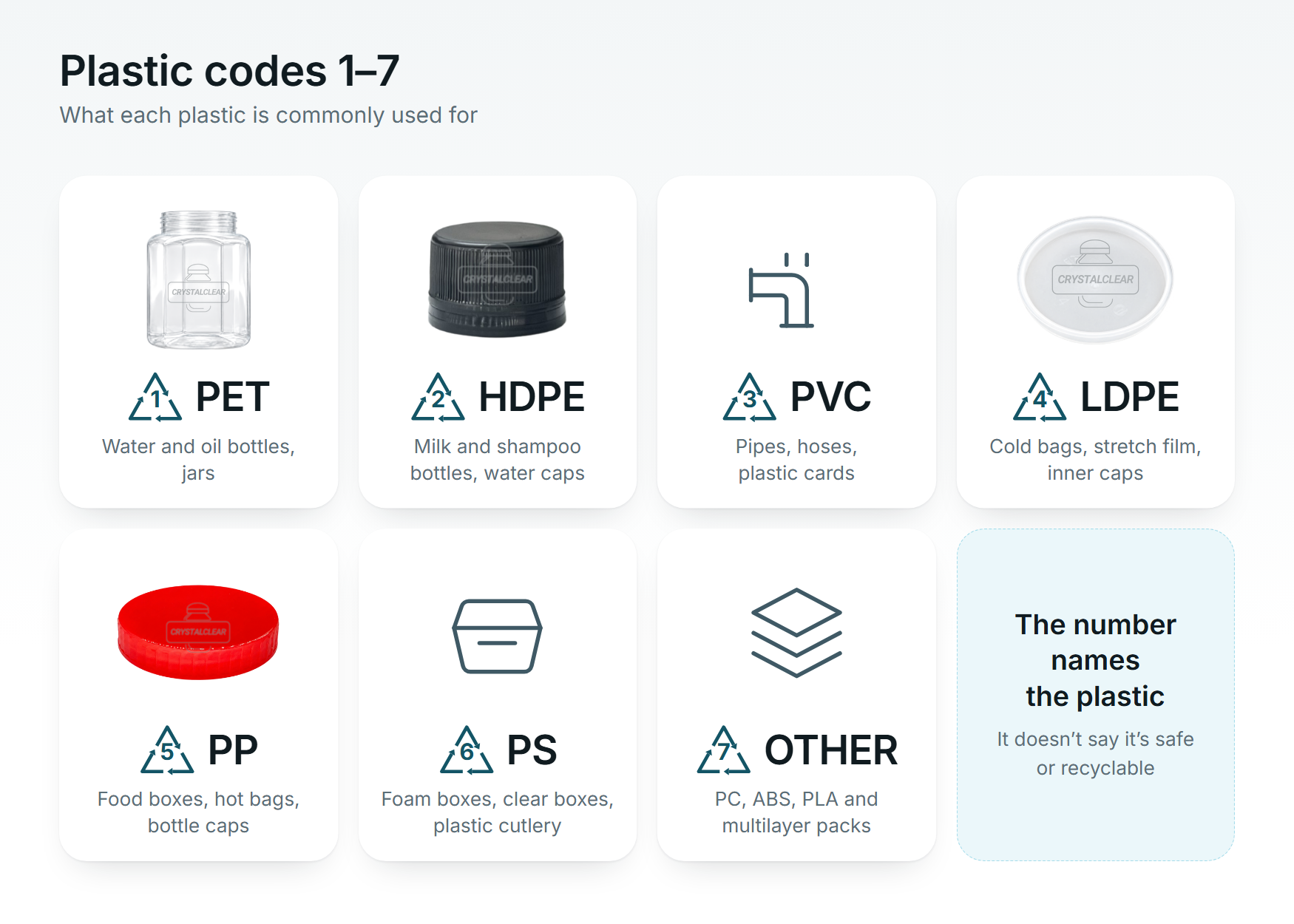
Code | Strengths | Common uses | Approx. heat limit |
|---|---|---|---|
1 PET | Clear, strong, good gas barrier | Water, cooking-oil and fish-sauce bottles, jars | About 70–80°C |
2 HDPE | Tough, resists chemicals and moisture | Milk, shampoo and dish-soap bottles | About 75°C |
3 PVC | Rigid or flexible | Water pipes, hoses, plastic cards | About 80°C |
4 LDPE | Soft, flexible, handles cold | Cold bags, stretch film, bread bags, inner caps | About 70°C |
5 PP | High heat resistance, resists chemicals and oil | Food boxes, hot bags, yogurt cups, bottle caps | About 110–140°C |
6 PS | Clear but brittle; includes foam | Foam boxes, clear boxes, plastic cutlery | About 95°C |
7 OTHER | Not one of the first six, or a mix | PC, ABS, PLA, multilayer packs | Depends on the plastic |
Heat limits are approximate figures from Hong Kong's Centre for Food Safety and Mahidol University's Faculty of Pharmacy. Real items vary with their formula and how they are made, so always go by the temperature printed on the product.
Code 1: PET (polyethylene terephthalate)
Clear, light, strong and a good gas barrier, so it is used for drink bottles, cooking-oil and sauce bottles and food jars. It suits chilled and room-temperature products. Ordinary PET bottles start to deform at around 70°C, so they are not for very hot liquids or the microwave; hot filling needs special heat-set PET bottles.
Thailand's FDA advises that PET drinking-water bottles are made for single use and should not be reused many times, because they are hard to clean thoroughly and can build up germs and dirt, and that they should not be left in the sun or a hot place for long.
Clear PET bottles are among the plastics junk shops want most. PET is also the only plastic that Ministry of Public Health Notification No. 435 allows to be mechanically recycled from used packaging back into food containers (rPET), after a safety assessment. Read more in rPET and PCR plastic explained.
Code 2: HDPE (high-density polyethylene)
Tough, impact-resistant and resistant to moisture and chemicals, and usually cloudy or opaque. It is used for milk, shampoo, laundry-detergent and dish-soap bottles, and for some drinking-water bottle caps. It handles cold very well but not much heat, and it is not a material for reheating food in the microwave.
Cloudy and milky-white HDPE is in demand with junk shops. Recycled HDPE becomes motor-oil bottles, pipes, plastic crates and plastic lumber.
Code 3: PVC (polyvinyl chloride)
Comes in rigid and flexible forms and is mostly used for water pipes, hoses, wire insulation, document folders and plastic cards. In food use it appears in some cling films and in the gaskets of metal lids on glass jars. Flexible PVC contains additives that keep it soft and can migrate into food, so don't put hot food in PVC film or bags, and don't let cling film touch food in the microwave.
Never burn plastic, especially PVC — burning chlorine-containing plastic produces dioxins. PVC scrap is hard to recycle, fetches little, and lowers the quality of recycled PET if it gets mixed in with PET bottles.
Code 4: LDPE (low-density polyethylene)
Soft, flexible and good in the cold, but it doesn't take much heat (about 70°C). It is used for cold bags, stretch film, bread bags and the inner caps of jars. It suits cold and frozen food; don't use it for hot food or in the microwave.
LDPE bags and film fetch little and many junk shops won't take them, but clean, dry film can go into the stretchable-plastic drop-off bins of Thailand's "วน" (Won) programme.
Code 5: PP (polypropylene)
The most heat-resistant of codes 1–6, and resistant to chemicals and oil, so it is used for food boxes, hot bags, yogurt cups, medicine bottles and bottle and jar caps. PP suits hot filling and is the main material for microwave containers.
But not every code-5 item is microwave-safe — yogurt and margarine tubs, for example. Always look for a Microwave Safe mark or TIS 2493. Single-use microwave containers shouldn't be reheated again, and some PP grades turn brittle in deep cold, so check the minimum temperature on the product before using it in the freezer.
Clear PP is in demand with junk shops. Recycled PP becomes brooms, brushes, battery cases and car parts.
Code 6: PS (polystyrene)
Comes as clear, rigid plastic (brittle and easy to crack) or as foam, used for foam boxes, clear boxes, cups and plastic cutlery. It tolerates only about 95°C, so don't put boiling food (100°C) in it: let very hot or fried food cool a little and drain the oil first, and don't put foam boxes in the microwave.
Foam food boxes are a phase-out target in Thailand's plastic waste roadmap, and food-soiled foam is almost never bought by junk shops.
Code 7: OTHER (other plastics)
Any plastic that isn't one of the first six, or a mix of several — for example PC (polycarbonate), ABS, PLA bioplastic and multilayer packaging. The plastic's name should be printed under the 7. So a 7 does not always mean BPA: BPA is a raw material of PC, not of every code-7 plastic. PLA only tolerates about 60°C, so it isn't suited to hot food. Most code-7 items are hard to recycle.
Which plastics can go in the microwave?
- Use containers marked Microwave Safe or Microwavable, or certified to TIS 2493 (plastic containers for reheating food in a microwave), which must withstand at least 100°C and show their minimum and maximum temperatures on the container.
- The materials TIS 2493 allows are PP, heat-resistant PET, PMMA and PMP — an ordinary PET water bottle is not a microwave container.
- Don't reheat food in plastic bags, foam boxes or yogurt and margarine tubs, and don't put melamine ware in the microwave.
- Keep cling film off the food while reheating, and leave a vent for steam.
- Don't reheat single-use containers a second time, and stop using containers that are warped, cracked or discoloured.
Common myths
- "Lower numbers are safer" or "1, 2, 4 and 5 are safe" — no credible source supports this. The number only names the plastic; food safety comes from how the item is made and tested under the law, such as Ministry of Public Health Notification No. 435 (2022).
- "Chasing arrows mean recyclable" — no, it is only the plastic code. Whether an item is actually recycled depends on whether someone buys it and on the local waste system.
- "A water bottle left in a hot car releases dioxins" — Thailand's Department of Medical Sciences tested bottled water left in cars parked in the sun for 1 and 7 days and found no dioxins; dioxins form in combustion above 450°C. Sustained heat does, however, increase antimony migration from PET, so keep drinking water out of the sun and away from heat.
- "Freezing a water bottle releases dioxins" — not true; cold does not create dioxins.
- "PET bottles contain BPA" — PET is not made from BPA, and Thailand's FDA found no BPA or phthalates in 30 bottled-water samples.
- "Every code-5 item is microwave-safe" — not true; always check the product's microwave marking.
How to read a plastic package label
- The number in the triangle and the abbreviation (for example 1 PET or 5 PP) name the plastic. Some products use the form >PP<, which means the same thing.
- Each part has its own code — for example a PET jar is 1, its PP cap is 5 and an LDPE inner cap is 4.
- The fork-and-spoon-on-a-plate symbol is the Thai standard's mark that a container is safe for food contact. It is a different mark from the plastic code.
- Use temperature — microwave containers under TIS 2493 must show their minimum and maximum temperatures.
- Warnings such as "single use" or "do not use in a microwave oven".
- The TIS mark — plastic food containers and utensils (TIS 655) and plastic microwave containers (TIS 2493) have been mandatory standards since 3 January 2023, and Thailand's industrial standards office advises checking for the mark every time you buy.
How to sort plastic so it gets recycled
Thailand's Pollution Control Department advises:
- Empty out liquids and food; if the item is dirty, rinse it, then let it dry.
- Peel off tape, paper and stickers.
- Sort by plastic type, keep it apart from food waste and hazardous waste, and keep cooking-oil bottles separate from water bottles.
- Don't leave it out in the sun or rain for long — the plastic degrades.
- Sell it to a junk shop (ร้านรับซื้อของเก่า), take it to a drop-off point or hand it to your local waste collection.
Most junk shops buy clear PET bottles and HDPE, and clear PP is also in demand. Bags and film fetch little. Some shops take black plastic and clean foam but pay less for them, while multilayer packs and food-soiled items, such as food-soiled foam boxes, usually find no buyer. What is accepted, and at what price, varies by shop and area.
Since 1 January 2025 Thailand has banned imports of plastic scrap, so recyclers depend on plastic sorted within Thailand — which makes household sorting matter more than ever.
For brand owners: choosing PET, HDPE or PP
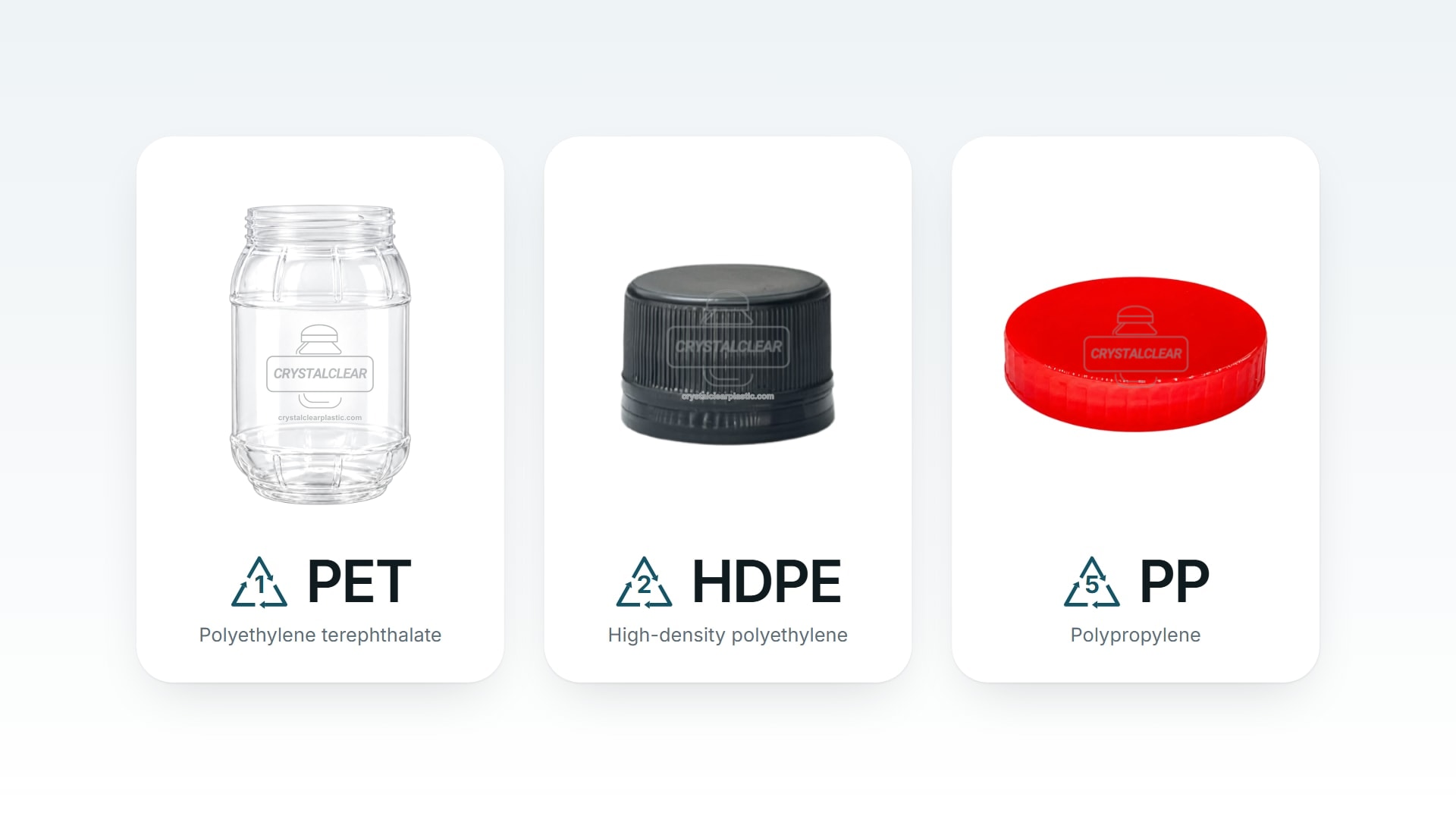
Choosing the right packaging material directly affects product quality, shelf life, and brand image. PET, HDPE and PP are widely used for food bottles, jars and caps, and each has different strengths.
PET offers glass-like clarity at a light weight, ideal for water, juices, and any product worth showing off. HDPE is naturally cloudy and chemical-resistant, suited to skincare and oils, and, when pigmented to be opaque, to light-sensitive goods. PP withstands high temperatures, making it the choice for hot-filled sauces and heat-processed foods.
| PET | HDPE | PP |
|---|---|---|---|
Plastic code | No. 1 | No. 2 | No. 5 |
Strengths | Glass-like clarity, light weight | Cloudy (opaque when pigmented), chemical-resistant | High heat resistance |
Best for | Water, juices, products worth showing off | Skincare, oils, light-sensitive goods (opaque grades) | Hot-filled sauces, heat-processed foods |
Also worth knowing:
- Both the container and the cap that touch food must comply with Ministry of Public Health Notification No. 435 (2022), which explicitly covers caps and stoppers.
- Design for recycling: clear PET is worth more to recyclers than opaque PET; PP and PE caps float, so recyclers can easily separate them from PET flakes; PVC labels or parts make PET harder to recycle.
- Crystalclear packaging: our jars and sauce bottles are PET (code 1), most caps are PP (code 5), the water-bottle cap is HDPE (code 2) and the inner caps and dome cap are LDPE (code 4). See the material of each model on its product page.
The Crystalclear team is happy to advise on material, size, and shape for your product. Contact us through any channel.
Sources
- Pollution Control Department: Characteristics of plastic scrap suitable for recycling, B.E. 2565 (Thai)
- Pollution Control Department: Thailand's Roadmap on Plastic Waste Management 2018–2030 (Thai)
- Mahidol University Faculty of Pharmacy: Plastic products and food (Thai)
- Mahidol University Faculty of Pharmacy: Which plastics can go in the microwave? (Thai)
- Department of Medical Sciences: Dioxins in bottled water left in parked cars (Thai)
- Thansettakij: Thai FDA on PET bottles, BPA and reuse (Thai)
- TISI: TIS 2493 Part 1-2554, plastic food containers for microwave ovens, Part 1: for reheating (Thai)
- TISI: TIS 655 Part 1-2553, plastic containers and utensils for food (Thai)
- Centre for Food Safety, Hong Kong: Know More about the Safe Use of Plastic Food Packaging and Containers
- ASTM D7611: Standard Practice for Coding Plastic Manufactured Articles for Resin Identification